


Carpet Cleaning Equipment Through the Ages: A Historical Overview of Innovation
Carpet Cleaning Equipment Through the Ages: A Historical Overview of Innovation https://www.carpetgurus.com/wp-content/uploads/Carpet-Cleaning-Equipment-History-1024x726.jpg 1024 726 Brandon Smith https://secure.gravatar.com/avatar/8e6588d4e69d33efb7d73d9ab24a09e4?s=96&d=mm&r=gThe ornate Persian rug beneath my feet tells a story of craftsmanship spanning centuries, but the real revolution lies not in how these textiles were made—it’s in how we’ve learned to keep them clean.
Carpet cleaning technology has undergone a transformation as dramatic as any industrial revolution, evolving from backbreaking manual labor to sophisticated machinery that would astound our Victorian ancestors.
My journey through this history began in the dusty archives of the Patent Office, where I discovered that our obsession with clean floors runs deeper than I ever imagined.
The Manual Era: Beating the Dust Out

Before machines, there was muscle. Early carpet cleaning methods relied entirely on human effort and simple tools that would make modern consumers wince. Homeowners in the 18th and early 19th centuries draped their rugs over clotheslines and attacked them with carpet beaters—woven wicker or wire implements designed to pummel dust and dirt into submission.
“My grandmother used to tell me stories about hanging rugs every spring,” recalls James Morrison, an 82-year-old industry veteran who started his career in the 1960s. “She’d spend entire days beating carpets, and the neighborhood would be covered in clouds of dust. It was brutal work.”
The process wasn’t just physically demanding—it was ineffective by today’s standards. Surface cleaning could only accomplish so much, leaving embedded dirt and allergens trapped deep within carpet fibers. Women (for this labor typically fell to them) would sweep carpets with stiff brooms, sometimes sprinkling damp tea leaves across the surface to trap dust particles. Salt, cornmeal, and even snow were employed as natural cleaning agents, each with varying degrees of success.
The First Mechanical Revolution
Everything changed in 1860 when Daniel Hess of West Union, Iowa, received a patent for the first mechanical carpet sweeper. His invention featured a rotating brush and elaborate bellows system designed to generate suction. The patent drawing, which I examined at the Smithsonian’s archives, shows a contraption that looks more like a medieval torture device than a household appliance.
Hess’s design never achieved commercial success, but it opened the floodgates of innovation. Melville Bissell, a crockery shop owner plagued by dusty carpets that aggravated his allergies, patented an improved carpet sweeper in 1876. Unlike Hess’s cumbersome creation, Bissell’s sweeper was practical, affordable, and actually worked. The Bissell Carpet Sweeper Company became a household name, and vintage advertisements from the 1890s—which I found in the Library of Congress collection—promised homemakers liberation from “the drudgery of carpet cleaning.”
These early advertisements reveal fascinating insights into social attitudes. One 1897 ad depicts a well-dressed woman effortlessly gliding a sweeper across her parlor, the tagline reading: “A gift that keeps on giving—to her and to you.” The subtext was clear: labor-saving devices weren’t just practical; they were status symbols.
The Vacuum Arrives

The true watershed moment came at the turn of the 20th century. Hubert Cecil Booth, a British engineer, witnessed a demonstration of an American machine that blew dust off seats in a railway car. Booth realized the fundamental flaw: why blow dust around when you could suck it up?
In 1901, Booth patented the first powered vacuum cleaner. His original machine was so large it had to be pulled by horses and parked outside homes while long hoses snaked through windows. The British Vacuum Cleaner Company offered cleaning services rather than selling the machines—an early example of service-based business models that would resurface in the digital age.
“Booth’s vacuum was revolutionary, but it wasn’t remotely practical for home use,” explains Dr. Sarah Chen, a technology historian I interviewed. “It took another decade before inventors miniaturized the technology enough for domestic applications.”
That miniaturization came from multiple sources. James Murray Spangler, a janitor from Canton, Ohio, cobbled together a crude portable vacuum cleaner in 1907 using a soap box, a fan, a pillowcase, and a broom handle. His invention worked so well that he patented it and sold the rights to William Hoover, his cousin’s husband. The Hoover Company transformed Spangler’s prototype into a commercial sensation.
Vintage Hoover advertisements from the 1920s showcase the “electric suction sweeper” as a modern marvel. One 1925 ad I uncovered features a gleaming chrome machine with the bold claim: “It BEATS as it Sweeps as it Cleans.” The triple-action promise—agitation, sweeping, and suction—represented a quantum leap in cleaning efficacy.
Post-War Innovation and Chemical Advances
The decades following World War II brought explosive growth in both carpet ownership and cleaning technology. Suburban expansion meant millions of new homes with wall-to-wall carpeting, creating unprecedented demand for effective cleaning solutions.
Steam cleaning emerged in the 1960s as a game-changing method. The technology, which actually uses hot water extraction rather than true steam, was pioneered by companies like Hoover and Rug Doctor. These machines injected hot water mixed with cleaning solution deep into carpet fibers, then immediately extracted the water along with dissolved dirt.
“When steam cleaners hit the market, we thought we’d reached the pinnacle,” Morrison tells me, leaning back in his chair at the carpet cleaning equipment museum he helped establish in Cincinnati. “Nobody imagined you could get carpets that clean without sending them out to professional cleaners.”
The introduction of synthetic detergents and specialized cleaning solutions paralleled these mechanical advances. Chemical companies developed formulas specifically engineered for carpet fibers, with varying pH levels optimized for different stains and materials. Patents from the 1970s reveal intense competition in the cleaning solution market, with companies racing to create more effective, faster-drying, and environmentally friendlier products.
The Modern Era: Power and Precision
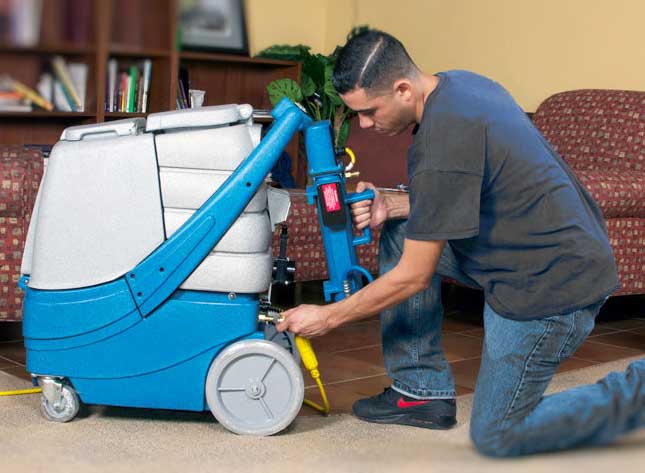
Setting up the EDIC Galaxy 2000
Today’s professional-grade carpet cleaning equipment would be unrecognizable to our Victorian ancestors. Truck-mounted extraction systems generate water pressure exceeding 500 PSI and vacuum power measured in hundreds of horsepower. These machines can heat water to nearly 240 degrees, achieving cleaning results that approach surgical-level sanitation.
Yet the consumer market has evolved differently. Compact portable extractors like the Bissell Little Green and similar devices offer homeowners convenient spot-cleaning capabilities. Robot vacuums equipped with carpet-detection sensors adjust their suction power automatically. Some high-end models even integrate with smart home systems, learning traffic patterns and adjusting cleaning schedules accordingly.
“We’ve come full circle in some ways,” observes Chen. “The Victorians had service providers bring equipment to homes. Now we have subscription services for robot vacuum maintenance and professional cleaning scheduled through apps.”
Green cleaning technology represents the current frontier. Low-moisture cleaning systems reduce water usage by up to 90% compared to traditional steam cleaning. Encapsulation cleaning, which surrounds dirt particles with polymer crystals that are then vacuumed away, eliminates the need for extensive drying time. Plant-based cleaning solutions have largely replaced harsh chemicals, addressing growing consumer concerns about indoor air quality and environmental impact.
Looking Forward
Standing in Morrison’s museum, surrounded by carpet sweepers, early vacuums, and hulking steam cleaners, I’m struck by how each innovation solved problems while creating new possibilities. The evolution of carpet cleaning equipment mirrors broader technological progress—from manual labor to mechanization, from chemical solutions to environmental consciousness, from ownership to service models.
What’s next? Industry insiders point to UV sterilization technology, nano-coating treatments that make carpets resist staining, and even enzymatic cleaning that uses bacteria to consume organic stains. The future of carpet cleaning may involve machines that prevent dirt accumulation rather than simply removing it.
Yet fundamentally, we’re still solving the same problem our ancestors faced: keeping the spaces where we live and work clean, comfortable, and healthy. The tools have changed dramatically, but the human desire for a pristine environment endures across centuries.
If you buy something on this page, we may get a small share of sale at no additional cost to you. We only recommend products that we have used ourselves and feel are really useful, not because of the limited compensation from the links through our posts.




Leave a Reply