


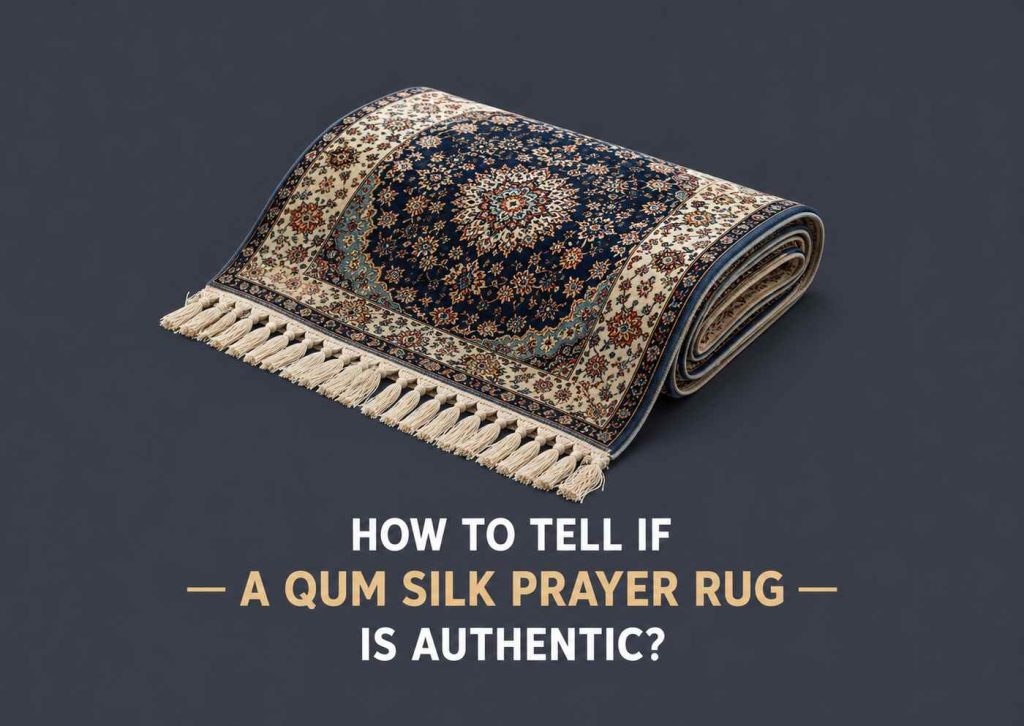
How to Tell If a Qum Silk Prayer Rug Is Authentic
How to Tell If a Qum Silk Prayer Rug Is Authentic https://www.carpetgurus.com/wp-content/uploads/qum-silk-prayer-rug-1024x726.jpg 1024 726 Rachelle Stone https://secure.gravatar.com/avatar/b903daecc57f726c767c59baf58630cd?s=96&d=mm&r=gA genuine Qum silk prayer rug can stop a room mid-conversation. Light hits the pile and the whole surface seems to shift color, the medallions and prayer niche glowing like stained glass. That shimmer is exactly what counterfeiters chase, and exactly what makes so many buyers uneasy before a purchase.
Knowing what separates a museum-worthy Qum piece from a clever imitation takes more than admiring the sheen. It calls for a closer look at material, construction, and the small details forgers rarely bother to replicate.
Understand What Sets a Qum Silk Rug Apart
Qum, also spelled Qom or Ghom, sits roughly two hours south of Tehran, and its weaving tradition is relatively young, dating to the 1920s and 1930s when master weavers relocated there from Kashan. Despite that short history, Qum silk rugs rank among the finest in the world, prized for extraordinary knot density and a jewel-like luster that shifts with the light.
Prayer rugs from the region typically feature a mihrab, or prayer niche, framed by intricate floral vines, cypress trees, or pictorial scenes rendered with almost architectural precision.
Collectors gravitate toward Qum pieces for the same reason forgers do: the city’s reputation for uncompromising craftsmanship translates directly into value. A well-documented Qum silk prayer rug can appreciate steadily over decades, which means the stakes of misidentifying one, in either direction, are real money.
Learning the region’s hallmarks before shopping puts a buyer in a far stronger position than relying on a seller’s word alone.
Count the Knots
Authentic Qum silk pieces are woven at extraordinarily high densities, often reaching 600 to 650 knots per square inch, sometimes higher in the finest examples. Wool Qum rugs, by comparison, typically fall between 130 and 320 knots per square inch.
Turning back a corner of the rug and counting knots within a one-inch square gives a reliable baseline. Loose, uneven, or noticeably sparse knotting points to a lower-grade rug, or one produced outside Qum entirely, since machine-made and budget imitations rarely approach this density.
Test the Silk Itself
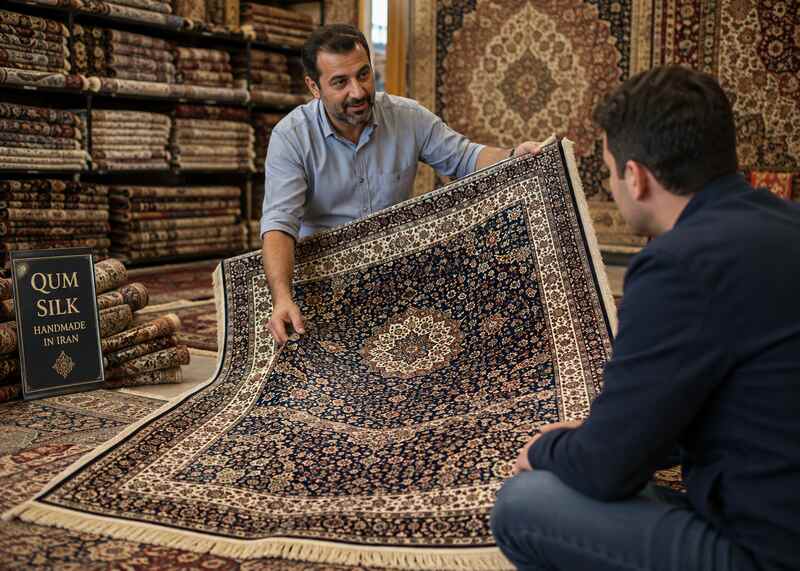
Genuine mulberry silk feels cool, smooth, and faintly waxy to the touch, with a soft sheen rather than a plasticky gloss. Rub the pile gently between two fingers; real silk generates almost no static and never feels synthetic.
Many counterfeits substitute mercerized cotton or rayon, sometimes marketed misleadingly as “art silk” or “bamboo silk.” These fibers can look convincing under showroom lighting but lack silk’s natural depth of color and tend to flatten or pill quickly.
A burn test on a loose thread from the fringe, if a seller allows it, settles the question outright: natural silk singes slowly, smells faintly like burning hair, and leaves a crumbly, dark ash, while synthetic fibers melt, curl, and give off a chemical odor.
Study the Back of the Rug
Flip it over. On a hand-knotted Qum, individual knots should be crisp and clearly visible, mirroring the front pattern with near-photographic accuracy. Machine-made rugs and lower-quality tufted pieces often show a fuzzy, glued, or uniformly mechanical backing instead.
Running a hand across the surface tells its own story; a tufted rug typically hides a canvas backing glued in place to hold the pile, something no genuine Qum weaver would ever use.
Examine the Precision of the Design
Curvilinear florals, tightly controlled borders, and outlines so clean they resemble printing rather than weaving are hallmarks of true Qum craftsmanship. Symmetry matters here: compare both sides of the mihrab arch and the corner medallions closely.
Genuine pieces reveal minute, human variation, an asymmetry born of hand weaving, while poor imitations tend to show awkward repetition or blurred detail wherever a machine, or a rushed weaver, cut corners.
Color depth deserves the same scrutiny. Fine Qum silk absorbs and reflects light in layers, so a medallion can look burgundy from one angle and nearly violet from another. Flat, single-tone color that never shifts, no matter how the rug catches the light, usually signals synthetic dye or synthetic fiber rather than naturally dyed silk.
Check the Fringe and Foundation
Fringe on an authentic Qum is simply the continuation of the foundation’s warp threads, never a separate strip sewn or glued onto the edge.
Tug gently; if it pulls away cleanly or looks stitched on afterward, treat that as a warning sign. Foundation threads should be silk or fine cotton, tightly and evenly woven, without visible gaps or knots showing through irregularly.
Look for a Weaver’s Signature
Many of the finest Qum silk rugs carry a signature woven directly into the border, usually in Persian script naming the master weaver or workshop. Locating a signature and cross-referencing it against known Qum ateliers adds real weight to a rug’s story.
An unsigned piece isn’t automatically suspect, but a documented, verifiable signature meaningfully raises both confidence in authenticity and resale value.
Be Wary of Common Imitations
Chinese-made copies, and increasingly machine-loomed pieces, flood the market under the Qum or Ghom label. These imitations often lean on synthetic silk substitutes, lower knot counts, and design motifs that echo Qum florals without matching their crispness or color depth.
Prices well below market rate for a silk piece of comparable size are usually the clearest tell of all; a genuine Qum silk rug demands months of skilled labor and simply cannot be produced cheaply.
Verify Provenance and Documentation
Whenever possible, buy from a dealer who can provide a certificate of authenticity, a formal appraisal, or a documented chain of ownership. Established rug specialists and reputable auction houses can usually trace a piece’s origin, age, and fiber content through expert appraisal.
If a seller hesitates over basic questions about knot count, material, or weaving region, that hesitation tells you almost everything you need to know.
Bring It All Together
Spotting a genuine Qum silk prayer rug comes down to patience and a willingness to look past the shimmer. Count the knots, test the fiber, flip it over, and ask the questions a confident seller should welcome.
Do that, and the rug you bring home will be exactly what it promises: a small, luminous piece of Persian mastery.
If you buy something on this page, we may get a small share of sale at no additional cost to you. We only recommend products that we have used ourselves and feel are really useful, not because of the limited compensation from the links through our posts.



Leave a Reply